Sustain Greenville
  • Home
  • Events
    • CALENDAR
    • Book Review
    • Earth Day
    • Farmers Market
    • Recycling
  • Resources
    • Native Plants
    • Chickens
  • Contact Us
    • Bicycling Support -
    • Earth Day -
    • Farmers Market -
    • Membership -
    • Native Plants -
    • Other -
    • Public Presentations -
    • Rain Barrels -
    • Recycling -
  • Native Plants
  • Weekly Blog
  • Home
  • Events
    • CALENDAR
    • Book Review
    • Earth Day
    • Farmers Market
    • Recycling
  • Resources
    • Native Plants
    • Chickens
  • Contact Us
    • Bicycling Support -
    • Earth Day -
    • Farmers Market -
    • Membership -
    • Native Plants -
    • Other -
    • Public Presentations -
    • Rain Barrels -
    • Recycling -
  • Native Plants
  • Weekly Blog

Native Plants:  Why you should consider them for your gardens and landscaping.

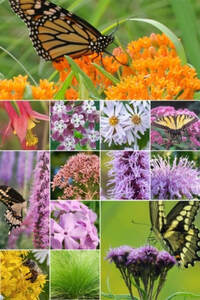
Photo from prairieanursery.com with permission

History and Definition                           Benefits                             Getting Started                            Resources

History and Definition

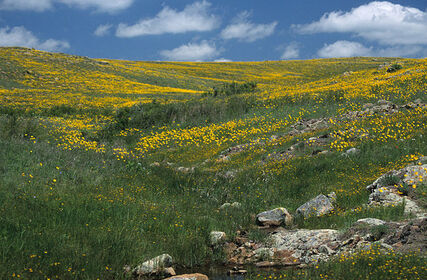
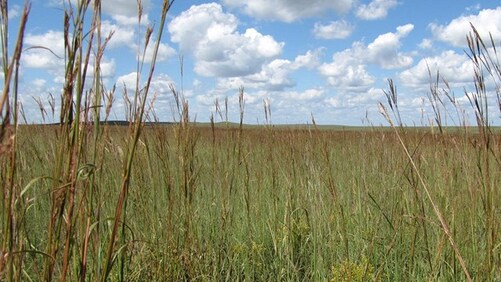
​Originally, there were about 170 million acres of tall grass prairie in the US consisting of tall grasses, up to 6-8 feet, and forbs (basically, flowering weeds).  All but about 4% has been converted to agriculture, and only remnants remain, much of it in three preserves, the Wichita Mountains Wildlife Refuge in Oklahoma (60,000 acres), the Tall Grass National Preserve in Kansas and the Konza Prairie Biological Station (8616 acres), also in Kansas.  The last two are part of a region called the Flint Hills (~4 million acres) that is about 75 miles wide that extends about two hundred miles between the north and south borders of the state.  Kansa State University uses the Konza Prairie Biological Station for research.  A good example of a restored tallgrass prairie is a 40 acre or so plot at the NE corner of County G and County SS in Kettle Moraine State Forest North.  All four are close to true tallgrass prairies and great places to visit for prairie enthusiasts.  
Picture
Wichita Mountains Wildlife Refuge - provided by Fish and Wildlife Service
Picture
Provided by nps with appreciation.
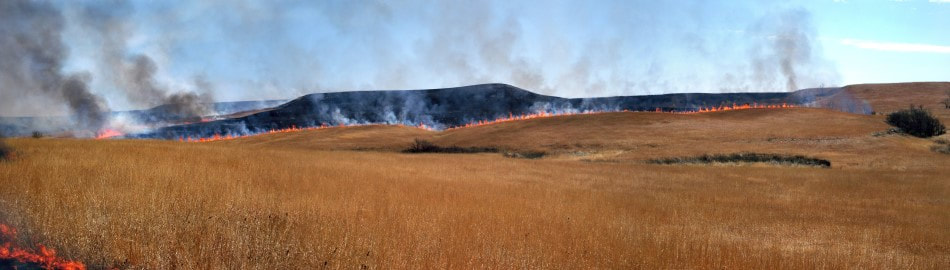
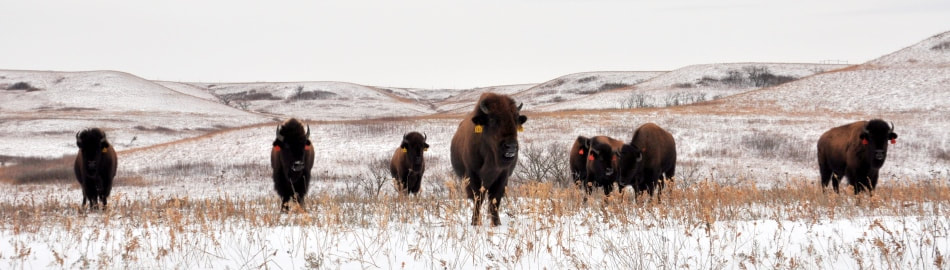
​Privately held areas are mostly managed for grazing, so the residual fuel is burned every 3-4 years to keep the forbs, shrubs and trees in check, leaving little but grass.  In reality, these are grasslands and not native prairies.   Such burning is common in the Flint Hills, usually in April before the grass has started to grow.  It is an amazing sight as the photo below of burning the Konza Prairie shows, and even more dramatic when conducted at night, which is very common.  Nature provided the occasional burning before man took over.
Picture
From Konza Prairie Biological Station - with permission.
Picture
From Konza Prairie Biological Station - with permission.
​For this article, a Native Plant is anything that would have been found in the original tall grass prairie, be it grass or forb.

Native Plants have many things to offer for use in gardens or landscaping.  Here are a few.

1. Massive root systems, extending down as deep as 15 feet containing about half carbon.  As a result, grasslands are more effective at sequestering carbon than forests of equal acreage.  Native plant roots live decades and do not burn in an above ground fire so no root carbon is released.
2. Native plants are resistant to and almost immune from drought.  They require no fertilizer or pesticides and no mowing or tilling, a further significant avoidance of carbon generation.
​3. Deep roots bind the soil to minimize erosion and runoff, and what runoff does occur carries no fertilizer or pesticides, making them very friendly to groundwater.
4. Great diversity is inherent in the plants themselves (500 species) and enhanced by the attraction of a wide variety of pollinators, including but not limited to honeybees, plus small animals and birds.  Finches especially like to feed on the seeds in the fall.
5. Once established, native plants require almost no care, thus reducing gardening workload.
6. Many native plants serve as host or nectar plants for butterflies, adding another attraction to the native plant garden.  

Getting Started:  Here are a few suggestions to help with this process.

​1. Start small with a few plants and a small area.  Mix native and domestic plants if it helps achieve a desired result.
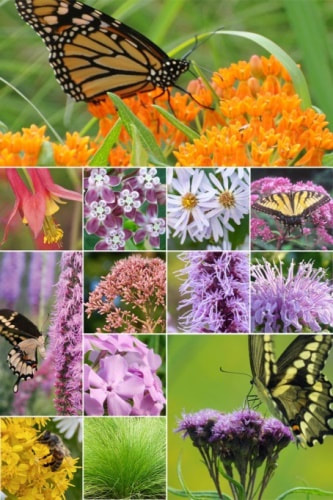
2. Start with plants or, at the most, a preplanned plant garden.  Native plants that have been started by others are easy to grow, provide an immediate result, and a high chance of success.  A few plants will produce many more in a short time either from divisions or seeds.  Preplanned gardens like the butterfly garden (right above) are available for various soil types, growth height, moisture conditions, special purposes and light levels, and include a planting plan. 
3. Work with a reputable source that provides good supporting resources.  Prairie Nursery in Westfield, Wisconsin is one such source.  See the links below for more resources.
4. Some good plants to start with:  Grasses – prairie dropseed and little bluestem, especially the cultivar blue heaven (right below).  Forbs – butterfly weed, prairie or Ohio spiderwort, red milkweed, cardinal flower, giant blue lobelia, and purple prairie clover.
5. Recognize that native plant seeds have many built in mechanisms to delay germination until conditions are likely to produce a thriving plant.  Because of this, native plant seeds usually require some sort of conditioning process, called stratification, to encourage/assure germination.  This is one good reason for starting with plants.
6. Also note that native plants evolved in a very diverse prairie where competition from other plants was intense.  As a result, some native plants have developed aggressive competitive patterns (see at the bottom of the page) and can become invasive.  Good resources will provide warnings of the worst offenders, Fireweed being a good example.  Although Fireweed is beautiful (state flower of Alaska) don’t ever plant it as you will not be able to control it.
7. Starting a native prairie and all the diversity it entails is a more complex process that takes time and effort to produce good results, but the result is well worth the effort.  Again, good resources will provide detailed instructions and seed mixtures for such a project.
Picture
Picture
From prairienursery.com with permission.

Other Resources


1. Relative eco-friendliness of manicured lawns and native plantings: https://dumpster.co/blog/well-manicured-lawn-vs-native-garden/
2. Great resource for plants, seeds, preplanned gardens, plant kits and supporting information:  prairienursery.com
3. Another source of help:  nativegardendesigns.wildones.org/
4. Wisconsin butterfly chart listing host and nectar plants.  https://wisconsinpollinators.com/BU/BA_HostNectarPlants.aspx
5. Listing of native plant sources in Wisconsin : https://wisconsinpollinators.com/Garden/G_Nurseries.aspx
6. Plans for a butterfly feeder: https://myfrugaladventures.com/2017/03/how-to-make-a-butterfly-feeder/
7. Seed stratification chart:  https://www.prairienursery.com/media/pdf/seed-propagation.pdf
8. https://www.fws.gov/refuge/wichita-mountains
9. https://www.nps.gov/tapr/index.htm
10. https://kpbs.konza.k-state.edu/
11. See people in the area regenerating biodiversity https://homegrownnationalpark.org/

"Invasives" are plants that dominate their neighbors and become a problem.  They become invasive by using one or more of these characteristics.

1. Produce abundant viable seeds. For example, each garlic mustard plant can produce hundreds to thousands of seeds.
2. Produce seeds that germinate and leaves that leaf out early in the spring, and they keep their leaves late into the fall,
allowing them to photosynthesize earlier and later than native plants. For example, Norway maple seedlings can be 6
inches tall before native maples sprout, and buckthorns keep their leaves into November, long after native plants
have lost theirs.
3. Have few pests or diseases. Non-native plants did not arrive in Vermont with the accompanying pests and diseases
that kept them in check in their native environments.
4.   May produce chemicals that make it difficult for other plants to grow nearby.
5. Invade a wide variety of soil types, moisture regimes and light conditions. Invasives are typically generalists and can
be difficult to kill.
6. Often produce monocultures over large areas so few other species can reproduce and grow. For example, wild
chervil, Japanese knotweed, and goutweed are just a few invasives that spread quickly and cover large areas,
eliminating the diversity of species that once grew on that site.
7. Reproduce both sexually and asexually (through a rhizomatous root system), making it easier for them to spread far
and wide.
Sustain Greenville | Greenville Wisconsin
​Based in Greenville Wisconsin, Sustain Greenville is a volunteer organization that promotes eco-friendly activities that support a sustainable environment. We sponsor the Sustain Greenville Farmers’ Market and several recycling and educational events. You are invited and encouraged to get involved and participate!
​Sustain Greenville
W6860 Parkview Dr.,
Greenville, WI 54942


​Website Design by Alco Web Design LLC